
Publications

Spontaneous galloping of a vibrating bubble along a solid boundary. Part 3: Theory
Tamim, S. I., Magoon, C. W., Sáenz, P. J
submitted
We develop a theoretical framework to rationalize the spontaneous symmetry-breaking instability and propulsion mechanism underlying ``galloping’’ bubbles. We consider an incompressible hemispherical sessile bubble attached to a solid wall with a freely moving contact line and subjected to vertical forcing. Assuming weak viscosity and small interface deformations, we formulate a nearly inviscid potential-flow problem and analyze its stability using a multiple-scale perturbation approach. We show that at low forcing the bubble undergoes harmonic axisymmetric oscillations directly driven by the vertical forcing, while non-axisymmetric modes arise only through parametric instability beyond a critical threshold. We further analyze the nonlinear saturation of the resonant unstable mode and derive expressions for the instability threshold, and the saturated amplitude and phase shift. Approximating the free-surface dynamics by the two dominant modes, we then perform an inviscid momentum balance that rationalizes galloping as a minimal realization of swimming in a perfect fluid, elucidating how net propulsion emerges along a direction where no external forcing is applied, and yielding an expression for the steady galloping speed in terms of the driving parameters. The resulting theoretical scalings are tested against simulations of the full system, showing agreement within the weakly nonlinear regime. Finally, we show that the reduced two-mode propulsion model admits a geometric interpretation in which the propulsion speed is proportional to the area enclosed by closed loops in a reduced shape space, thereby identifying galloping bubbles as a spontaneous realization of nearly inviscid geometric swimming.

Spontaneous galloping of a vibrating bubble along a solid boundary. Part 2: Simulations
Magoon, C. W., Tamim, S. I., Sáenz, P. J
submitted
Using direct numerical simulations, we investigate the ``galloping'' self-propulsion of an incompressible gas bubble underneath a horizontal wall subjected to vertical vibrations. Previous work showed that this spontaneous symmetry breaking arises both for bubbles pressed against the wall by buoyancy but separated from it by a thin film, and for hemispherical sessile bubbles attached to the wall with a freely moving contact line. Here, we present a side-by-side comparison of the two configurations across an extended parameter space. Particular attention is given to the evolution of the interface deformation and its modal spectrum as the driving amplitude increases: from the static base geometry, through harmonic axisymmetric oscillations at weak forcing, to the onset of rectilinear galloping triggered by the destabilization of non-axisymmetric modes. We further demonstrate that the transient propulsion speed grows exponentially in synchrony with a resonant non-axisymmetric shape mode, establishing a direct dynamical link between interfacial deformation and locomotion. We also characterize the associated two-phase flow fields underlying the bubble propulsion. Finally, we show that the steady rectilinear galloping speeds collapse onto power-law scalings in both configurations, and present a first numerical characterization of orbital galloping motion, which arises through a secondary symmetry breaking of the interface.
Spontaneous galloping of a vibrating bubble along a solid boundary. Part 1: Experiments
Guan, J. H., Liu, X., Tamim, S. I., Magoon, C. W., Sáenz, P. J
submitted
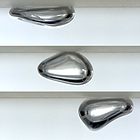
When held beneath the upper wall of a vertically vibrated fluid chamber by buoyancy, capillary-sized bubbles have been shown to spontaneously break symmetry and self-propel along the wall, exhibiting a gallop-like motion. These `galloping' bubbles become motile in the plane perpendicular to the external driving by virtue of a resonant coupling between axisymmetric and non-axisymmetric shape oscillation modes, which are parametrically excited through the effective gravitational field. Here, we present a comprehensive experimental investigation of the galloping bubbles in terms of the system's principal control parameters, including bubble volume, driving frequency and amplitude, and fluid viscosity. For bubbles of varying sizes, we characterize their equilibrium shapes and resonances under low forcing, interpreting the emergent shape oscillations in terms of those of a hemispherical sessile bubble. At higher driving, we delineate the regions of the parameter space in which bubbles exhibit translational, orbital and run-and-tumble motions, as well as regimes where they detach from the wall or undergo breakup, and provide a characterization of the dynamics in each scenario. We further characterize the instantaneous flow fields surrounding the bubbles and derive a scaling law for the propulsion speed that captures the influence of the bubble geometry. We conclude by investigating the role of viscosity in shifting the instability threshold and galloping frequency, as well as in regulating the mixing of modes responsible for the different galloping states.

Anomalous interference drives oscillatory dynamics in wave-dressed active particles.
Blitstein, A. M., Rosales, R. R., & Sáenz, P. J.
arXiv, 2025. https://arxiv.org/abs/2504.08774
A recent surge of discoveries has sparked significant interest in active systems where a particle moves autonomously in resonance with its self-generated wave field, leading to notable wave-mediated effects including new propulsion mechanisms, self-sustained speed modulations, and quantum-like phenomena. Drawing from an archetypical model of wave-dressed active particles, we unveil a wave-mediated non-local force driving their oscillatory dynamics, arising from the particle’s path memory and an unconventional form of wave interference near jerking points, locations where the particle’s velocity changes rapidly. In contrast to the typical case of constructive interference at points of stationary phase, waves excited by the particle near jerking points avoid cancellation through rapid changes in frequency. Through an asymptotic analysis, we derive the wave force from jerking points, revealing it as an elusive yet crucial remnant of the particle's past motion. This previously unrecognized force underlies a range of phenomena formerly viewed as disparate, including in-line speed oscillations, wave-like statistics in potential wells, and non-specular reflections, thereby unifying them within a common framework rooted in generic wave superposition principles.

Galloping Bubbles.
Guan, J. H., Tamim, S. I., Magoon, C. W., Stone, H. A., & Sáenz, P. J.
Nature Communications, 16(1), 2025. https://doi.org/10.1038/s41467-025-56611-5
Despite centuries of investigation, bubbles continue to unveil intriguing dynamics relevant to a multitude of practical applications, including industrial, biological, geophysical, and medical settings. Here we introduce bubbles that spontaneously start to ‘gallop’ along horizontal surfaces inside a vertically-vibrated fluid chamber, self-propelled by a resonant interaction between their shape oscillation modes. These active bubbles exhibit distinct trajectory regimes, including rectilinear, orbital, and run-and-tumble motions, which can be tuned dynamically via the external forcing. Through periodic body deformations, galloping bubbles swim leveraging inertial forces rather than vortex shedding, enabling them to maneuver even when viscous traction is not viable. The galloping symmetry breaking provides a robust self-propulsion mechanism, arising in bubbles whether separated from the wall by a liquid film or directly attached to it, and is captured by a minimal oscillator model, highlighting its universality. Through proof-of-concept demonstrations, we showcase the technological potential of the galloping locomotion for applications involving bubble generation and removal, transport and sorting, navigating complex fluid networks, and surface cleaning. The rich dynamics of galloping bubbles suggest exciting opportunities in heat transfer, microfluidic transport, probing and cleaning, bubble-based computing, soft robotics, and active matter.

Diffraction of walking drops by a standing Faraday wave.
Primkulov, B. K., Evans, D. J., Frumkin, V., Sáenz, P. J., & Bush, J. W. M.
Physical Review Research, 7(1), 13226, 2025. https://doi.org/10.1103/PhysRevResearch.7.013226
The Kapitza-Dirac effect is the diffraction of quantum particles by a standing wave of light. We here report an analogous phenomenon in pilot-wave hydrodynamics, wherein droplets walking across the surface of a vibrating liquid bath are deflected by a standing Faraday wave. We show that, in certain parameter regimes, the statistical distribution of the droplet deflection angles reveals a diffraction pattern reminiscent of that observed in the Kapitza-Dirac effect. Through experiments and simulations, we show that the diffraction pattern results from the complex interactions of the droplets with the standing wave. Our study highlights nonresonant effects associated with the detuning of the droplet bouncing and the bath vibration, which are shown to lead to drop speed variations and droplet sorting according to the droplet's phase of impact. We discuss the similarities and differences between our hydrodynamic system and the discrete and continuum interpretations of the Kapitza-Dirac effect, and introduce the notion of ponderomotive effects in pilot-wave hydrodynamics.

Anderson localization of walking droplets.
Abraham, A. J., Malkov, S., Ljubetic, F. A., Durey, M., & Sáenz, P. J.
Physical Review X, 14(3), 31047, 2024. https://doi.org/10.1103/PhysRevX.14.031047
Understanding the ability of particles to maneuver through disordered environments is a central problem in innumerable settings, from active matter and biology to electronics. Macroscopic particles ultimately exhibit diffusive motion when their energy exceeds the characteristic potential barrier of the random landscape. In stark contrast, wave-particle duality causes subatomic particles in disordered media to come to rest even when the potential is weak -- a remarkable phenomenon known as Anderson localization. Here, we present a hydrodynamic active system with wave-particle features, a millimetric droplet self-guided by its own wave field over a submerged random topography, whose dynamics exhibits localized statistics analogous to those of quantum systems. Consideration of an ensemble of particle trajectories reveals a suppression of diffusion when the guiding wave field extends over the disordered topography. We rationalize mechanistically the emergent statistics by virtue of the wave-mediated resonant coupling between the droplet and topography, which produces an attractive wave potential about the localization region. This hydrodynamic analog, which demonstrates how a classical particle may localize like a wave, suggests new directions for future research in various areas, including wave localization, many-body localization, and topological matter.

Perspectives on pilot-wave hydrodynamics.
Bush, J. W. M., Frumkin, V., & Sáenz, P. J.
Applied Physics Letters, 125(3), 030503, 2024. https://doi.org/10.1063/5.0210055
We present a number of fresh perspectives on pilot-wave hydrodynamics, the field initiated in 2005 by Couder and Fort's discovery that millimetric droplets self-propelling along the surface of a vibrating bath can capture certain features of quantum systems. A recurring theme will be that pilot-wave hydrodynamics furnishes a classical framework for reproducing many quantum phenomena and allows one to rationalize such phenomena mechanistically, from a local realist perspective, obviating the need to appeal to quantum nonlocality. The distinction is drawn between hydrodynamic pilot-wave theory and its quantum counterparts, Bohmian mechanics, the Bohm-Vigier stochastic pilot-wave theory, and de Broglie's theory of the double-solution. Each of these quantum predecessors provide a valuable touchstone as we take the physical picture engendered in the walking droplets and extend it into the quantum realm via theoretical modeling. Emphasis is given to recent developments in the field, both experimental and conceptual, and to forecasting potentially fruitful new directions.

Minimal Quantization Model in Pilot-Wave Hydrodynamics.
Blitstein, A. M., Rosales, R. R., & Sáenz, P. J.
Physical Review Letters, 132(10), 104003, 2024. https://doi.org/10.1103/PhysRevLett.132.104003
Investigating how classical systems may manifest dynamics analogous to those of quantum systems is a broad subject of fundamental interest. Walking droplets, which self-propel through a resonant interaction with their own wave field, provide a unique macroscopic realization of wave-particle duality that exhibits behaviors previously thought exclusive to quantum particles. Despite significant efforts, elucidating the precise origin and form of the wave-mediated forces responsible for the walker's quantumlike behavior remained elusive. Here, we demonstrate that, owing to wave interference, the force responsible for orbital quantization originates from waves excited near stationary points on the walker's past trajectory. Moreover, we derive a minimal model with the essential ingredients to capture quantized orbital dynamics, including quasiperiodic and chaotic orbits. Notably, this minimal model provides an explicit distinction between local forces, which account for the walker's preferred speed and wave-induced added mass, and spatiotemporal nonlocal forces responsible for quantization. The quantization mechanism revealed here is generic, and will thus play a role in other hydrodynamic quantum analogs.

Traveling Faraday waves.
Guan, J. H., Magoon, C. W., Durey, M., Camassa, R., & Sáenz, P. J.
Physical Review Fluids, 110501(8), 1–5, 2023. https://doi.org/10.1103/PhysRevFluids.8.110501
This paper is associated with a video winner of a 2022 American Physical Society's Division of Fluids Dynamics (DFD) Milton van Dyke Award for work presented at the DFD Gallery of Fluid Motion. The original video is available online at the Gallery of Fluid Motion, https://doi.org/10.1103/APS.DFD.2022.GFM.V0040

Emergent universal statistics in nonequilibrium systems with dynamical scale selection.
Heinonen, V., Abraham, A. J., Slomka, J., Burns, K.J., Sáenz, P. J., Dunkel, J.
Pattern-forming nonequilibrium systems are ubiquitous in nature, from driven quantum matter and biological life forms to atmospheric and interstellar gases. Identifying universal aspects of their far-from-equilibrium dynamics and statistics poses major conceptual and practical challenges due to the absence of energy and momentum conservation laws. Here, we experimentally and theoretically investigate the statistics of prototypical nonequilibrium systems in which inherent length-scale selection confines the dynamics near a mean energy hypersurface. Guided by spectral analysis of the field modes and scaling arguments, we derive a universal nonequilibrium distribution for kinetic field observables. We confirm the predicted energy distributions in experimental observations of Faraday surface waves, and in quantum chaos and active turbulence simulations. Our results indicate that pattern dynamics and transport in driven physical and biological matter can often be described through monochromatic random fields, suggesting a path towards a unified statistical field theory of nonequilibrium systems with length-scale selection.

Emergent order in hydrodynamic spin lattices.
Sáenz, P. J., Pucci, G., Turton, S. E., Goujon, A., Rosales, R. R., Dunkel, J., & Bush, J. W. M.
Nature, 596(7870), 58–62, 2021. https://doi.org/10.1038/s41586-021-03682-1
Macroscale analogues1–3 of microscopic spin systems offer direct insights into fundamental physical principles, thereby advancing our understanding of synchronization phenomena4 and informing the design of novel classes of chiral metamaterials5–7. Here we introduce hydrodynamic spin lattices (HSLs) of ‘walking’ droplets as a class of active spin systems with particle–wave coupling. HSLs reveal various non-equilibrium symmetry-breaking phenomena, including transitions from antiferromagnetic to ferromagnetic order that can be controlled by varying the lattice geometry and system rotation8. Theoretical predictions based on a generalized Kuramoto model4 derived from first principles rationalize our experimental observations, establishing HSLs as a versatile platform for exploring active phase oscillator dynamics. The tunability of HSLs suggests exciting directions for future research, from active spin–wave dynamics to hydrodynamic analogue computation and droplet-based topological insulators.

A hydrodynamic analog of Friedel oscillations.
Sáenz, P. J., Cristea-Platon, T., & Bush, J. W. M.
Science Advances, 6(20), eaay9234, 2020. https://doi.org/10.1126/sciadv.aay9234
We present a macroscopic analog of an open quantum system, achieved with a classical pilot-wave system. Friedel oscillations are the angstrom-scale statistical signature of an impurity on a metal surface, concentric circular modulations in the probability density function of the surrounding electron sea. We consider a millimetric drop, propelled by its own wave field along the surface of a vibrating liquid bath, interacting with a submerged circular well. An ensemble of drop trajectories displays a statistical signature in the vicinity of the well that is strikingly similar to Friedel oscillations. The droplet trajectories reveal the dynamical roots of the emergent statistics. Our study elucidates a new mechanism for emergent quantum-like statistics in pilot-wave hydrodynamics and so suggests new directions for the nascent field of hydrodynamic quantum analogs.

Spin lattices of walking droplets.
Sáenz, P. J., Pucci, G., Goujon, A., Cristea-Platon, T., Dunkel, J., & Bush, J. W. M.
Physical Review Fluids, 3(10), 100508, 2018. https://doi.org/10.1103/PhysRevFluids.3.100508
This paper is associated with a video winner of a 2017 APS/DFD Gallery of Fluid Motion Award for work presented at the DFD Gallery of Fluid Motion. The original video is available from the Gallery of Fluid Motion, https://doi.org/10.1103/APS.DFD.2017.GFM.V0018

Walking droplets in a circular corral: Quantisation and chaos.
Cristea-platon, T., Sáenz, P. J., & Bush, J. W. M.
Chaos, 28(9), 096116, 2018. https://doi.org/10.1063/1.5034123
A millimetric liquid droplet may walk across the surface of a vibrating liquid bath through a resonant interaction with its self-generated wavefield. Such walking droplets, or “walkers,” have attracted considerable recent interest because they exhibit certain features previously believed to be exclusive to the microscopic, quantum realm. In particular, the intricate motion of a walker confined to a closed geometry is known to give rise to a coherent wave-like statistical behavior similar to that of electrons confined to quantum corrals. Here, we examine experimentally the dynamics of a walker inside a circular corral. We first illustrate the emergence of a variety of stable dynamical states for relatively low vibrational accelerations, which lead to a double quantisation in angular momentum and orbital radius. We then characterise the system’s transition to chaos for increasing vibrational acceleration and illustrate the resulting breakdown of the double quantisation. Finally, we discuss the similarities and differences between the dynamics and statistics of a walker inside a circular corral and that of a walker subject to a simple harmonic potential.

Statistical projection effects in a hydrodynamic pilot-wave system.
Sáenz, T. J., Cristea-Platon, T., & Bush, J. W. M.
Nature Physics, 14(3), 315–319, 2018. https://doi.org/10.1038/s41567-017-0003-x
Millimetric liquid droplets can walk across the surface of a vibrating fluid bath, self-propelled through a resonant interaction with their own guiding or ‘pilot’ wave fields. These walking droplets, or ‘walkers’, exhibit several features previously thought to be peculiar to the microscopic, quantum realm. In particular, walkers confined to circular corrals manifest a wave-like statistical behaviour reminiscent of that of electrons in quantum corrals. Here we demonstrate that localized topological inhomogeneities in an elliptical corral may lead to resonant projection effects in the walker’s statistics similar to those reported in quantum corrals. Specifically, we show that a submerged circular well may drive the walker to excite specific eigenmodes in the bath that result in drastic changes in the particle’s statistical behaviour. The well tends to attract the walker, leading to a local peak in the walker’s position histogram. By placing the well at one of the foci, a mode with maxima near the foci is preferentially excited, leading to a projection effect in the walker’s position histogram towards the empty focus, an effect strongly reminiscent of the quantum mirage. Finally, we demonstrate that the mean pilot-wave field has the same form as the histogram describing the walker’s statistics.

Hydrodynamic analog of particle trapping with the Talbot effect.
Sungar, N., Tambasco, L. D., Pucci, G., Sáenz, P. J., & Bush, J. W. M.
Physical Review Fluids, 2(10), 103602, 2017. https://doi.org/10.1103/PhysRevFluids.2.103602
We present the results of an experimental study of the standing waves produced on the surface of a vertically shaken fluid bath just above the Faraday threshold, when a row of equally spaced pillars protrudes from the surface. When the pillar spacing is twice the Faraday wavelength, the resulting wave field is marked by images of the pillars projected at integer multiples of a fixed distance from the row. This projection effect is shown to be analogous to the well-known Talbot or self-imaging effect in optics, and a Faraday-Talbot length is defined that rationalizes the location of the images. A simple model of point sources emitting circular waves captures the observed patterns. We demonstrate that the images may serve as traps for bouncing and walking droplets.

Dynamics and universal scaling law in geometrically-controlled sessile drop evaporation.
Sáenz, P. J., Wray, A. W., Che, Z., Matar, O. K., Valluri, P., Kim, J., & Sefiane, K.
Nature Communications, 8(1), 14783, 2017. https://doi.org/10.1038/ncomms14783
The evaporation of a liquid drop on a solid substrate is a remarkably common phenomenon. Yet, the complexity of the underlying mechanisms has constrained previous studies to spherically symmetric configurations. Here we investigate well-defined, non-spherical evaporating drops of pure liquids and binary mixtures. We deduce a universal scaling law for the evaporation rate valid for any shape and demonstrate that more curved regions lead to preferential localized depositions in particle-laden drops. Furthermore, geometry induces well-defined flow structures within the drop that change according to the driving mechanism. In the case of binary mixtures, geometry dictates the spatial segregation of the more volatile component as it is depleted. Our results suggest that the drop geometry can be exploited to prescribe the particle deposition and evaporative dynamics of pure drops and the mixing characteristics of multicomponent drops, which may be of interest to a wide range of industrial and scientific applications.

Non-specular reflection of walking droplets.
Pucci, G., Sáenz, P. J., Faria, L. M., & Bush, J. W. M.
Journal of Fluid Mechanics, 804, R3, 2016. https://doi.org/10.1017/jfm.2016.537
Since their discovery by Yves Couder and Emmanuel Fort, droplets walking on a vibrating liquid bath have attracted considerable attention because they unexpectedly exhibit certain features reminiscent of quantum particles. While the behaviour of walking droplets in unbounded geometries has to a large extent been rationalized theoretically, no such rationale exists for their behaviour in the presence of boundaries, as arises in a number of key quantum analogue systems. We here present the results of a combined experimental and theoretical study of the interaction of walking droplets with a submerged planar barrier. Droplets exhibit non-specular reflection, with a small range of reflection angles that is only weakly dependent on the system parameters, including the angle of incidence. The observed behaviour is captured by simulations based on a theoretical model that treats the boundaries as regions of reduced wave speed, and rationalized in terms of momentum considerations.

Evaporation of sessile drops: A three-dimensional approach.
Sáenz, P. J., Sefiane, K., Kim, J., Matar, O. K., & Valluri, P.
Journal of Fluid Mechanics, 772, 705–739, 2015. https://doi.org/10.1017/jfm.2015.224
The evaporation of non-axisymmetric sessile drops is studied by means of experiments and three-dimensional direct numerical simulations (DNS). The emergence of azimuthal currents and pairs of counter-rotating vortices in the liquid bulk flow is reported in drops with non-circular contact area. These phenomena, especially the latter, which is also observed experimentally, are found to play a critical role in the transient flow dynamics and associated heat transfer. Non-circular drops exhibit variable wettability along the pinned contact line sensitive to the choice of system parameters, and inversely dependent on the local contact-line curvature, providing a simple criterion for estimating the approximate contact-angle distribution. The evaporation rate is found to vary in the same order of magnitude as the liquid-gas interfacial area. Furthermore, the more complex case of drops evaporating with a moving contact line (MCL) in the constant contact-angle mode is addressed. Interestingly, the numerical results demonstrate that the average interface temperature remains essentially constant as the drop evaporates in the constant-angle (CA) mode, while this increases in the constant-radius (CR) mode as the drops become thinner. It is therefore concluded that, for increasing substrate heating, the evaporation rate increases more rapidly in the CR mode than in the CA mode. In other words, the higher the temperature the larger the difference between the lifetimes of an evaporating drop in the CA mode with respect to that evaporating in the CR mode.

Stability and two-phase dynamics of evaporating Marangoni-driven flows in laterally-heated liquid layers and sessile droplets.Sáenz, P. J., Valluri, P., Sefiane, K., & Matar, O. K.
Procedia IUTAM, 15, 116–123, 2015. https://doi.org/10.1016/j.piutam.2015.04.017
This paper investigates the linear and non-linear instabilities during evaporation of liquid layers and droplets by means of two-phase 3D direct numerical simulations. The interface is open to the atmosphere under the consideration that vapour diffusion is the rate- limiting mechanism for evaporation. In both configurations, the vapour-liquid interface is prone to travelling thermal instabilities, i.e., hydrothermal waves (HTWs), due to the presence of temperature gradients along the interface. We have already shown in our recent work 7 that under saturated conditions (negligible evaporation) the HTWs additionally give rise to interface deformations of similar features, i.e., physical waves. We have also demonstrated 8 that phase change plays a dual role through its effect on these instabilities: the latent energy required during the evaporation process tends to inhibit the HTWs while the accompanying level reduction enhances the physical waves by minimizing the role of gravity. The dynamics of the gas phase are also discussed. We have also established that the HTW-induced convective patterns in the gas along with the travelling nature of the instabilities have a significant impact on the local evaporation flux and the vapour distribution above the interface. The Marangoni effect plays a major role in the vapour distribution generating a vacuum effect in the warm region and vapour accumulations at the cold boundary capable of inverting the phase change, i.e., the capillary flow can lead to local condensation. These results provide evidence of the inefficiencies of the traditional phase change models based on pure vapour diffusion to capture the dynamics of thermocapillary flows. To conclude, we also present results of a parallel investigation focusing on three-dimensional phenomena on evaporating sessile drops placed on heated substrates.

On phase change in Marangoni-driven flows and its effects on the hydrothermal-wave instabilities.Sáenz, P. J., Valluri, P., Sefiane, K., Karapetsas, G., & Matar, O. K.
Physics of Fluids, 26(2), 024114, 2014. https://doi.org/10.1063/1.4866770
This paper investigates the effects of phase change on the stability of a laterally heated liquid layer for the first time. The interface is open to the atmosphere and vapor diffusion is the rate-limiting mechanism for evaporation. In this configuration, the planar layer is naturally vulnerable to the formation of travelling thermal instabilities, i.e., hydrothermal waves (HTWs), due to the presence of temperature gradients along the gas-liquid interface. Recent work carried out for deformable interfaces and negligible evaporation indicates that the HTWs additionally give rise to interface deformations of similar features, i.e., physical waves. The study presented here reveals that phase change plays a dual role through its effect on these instabilities: the latent energy required during the evaporation process tends to inhibit the HTWs while the accompanying level reduction enhances the physical waves by minimizing the role of gravity. The dynamics of the gas phase are also discussed. The HTW-induced convective patterns in the gas along with the travelling nature of the instabilities have a significant impact on the local evaporation flux and the vapor distribution above the interface. Interestingly, high (low) concentrations of vapor are found above cold (hot) spots. The phase-change mechanism for stable layers is also investigated. The Marangoni effect plays a major role in the vapor distribution generating a vacuum effect in the warm region and vapor accumulations at the cold boundary capable of inverting the phase change, i.e., the capillary flow can lead to local condensation. This work also demonstrates the inefficiencies of the traditional phase change models based on pure vapor diffusion to capture the dynamics of thermocapillary flows.

Linear and nonlinear stability of hydrothermal waves in planar liquid layers driven by thermocapillarity.
Sáenz, P. J., Valluri, P., Sefiane, K., Karapetsas, G., & Matar, O. K. Physics of Fluids, 25(9), 094101, 2013. https://doi.org/10.1063/1.4819884
A shallow planar layer of liquid bounded from above by gas is set into motion via the thermocapillary effect resulting from a thermal gradient applied along its interface. Depending on the physical properties of the liquid and the strength of the gradient, the system is prone to departure from its equilibrium state and to the consequent development of an oscillatory regime. This problem is numerically investigated for the first time by means of two-phase direct numerical simulations fully taking into account the presence of a deformable interface. Obliquely travelling hydrothermal waves (HTWs), similar to those first described by Smith and Davis [J. Fluid Mech. 132, 119–144 (1983)] , are reported presenting good agreement with linear stability theory and experiments. The nonlinear spatiotemporal growth of the instabilities is discussed extensively along with the final bulk flow for both the liquid and gas phases. Our study reveals the presence of interface deformations which accompany the HTWs pattern with a certain time-delay. The local interface heat fluxes are found to be significantly affected by the transient nature of the HTWs, contradicting the results of previous single-phase studies.