
Galloping Bubbles
Spontaneous self-propulsion of bubbles.

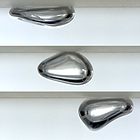
This line of research was initiated with our discovery of galloping bubbles, a new mode of self-propulsion that arises when a millimetric bubble resting against the inside wall of a vertically vibrated fluid chamber is driven beyond a critical threshold. Nonlinear coupling between the bubble’s shape oscillations leads to spontaneous symmetry breaking and sustained horizontal motion, perpendicular to the forcing direction.
In contrast to conventional propulsion mechanisms that rely on imposed asymmetries, galloping bubbles move while maintaining zero net linear momentum and without viscous traction, their motion arising purely from nonreciprocal body deformations and inertial forces. Individual bubbles exhibit a rich variety of behaviors — including rectilinear motion, orbiting trajectories, and run-and-tumble dynamics — all stemming from the nonlinear coupling between oscillatory modes and the surrounding fluid. They can navigate mazes, self-sort and even clean surfaces, suggesting potential uses in microfluidic transport, and heat-transfer applications.
When interacting, galloping bubbles exhibit rich collective behaviors arising from their deformable bodies, leading to lattice arrangements, coordinated motion, clustering, and other emergent dynamics. This minimal system reveals a new route to self-organized locomotion at fluid interfaces and illustrates how parametric instabilities can endow deformable bodies with motility.
Introducing Galloping Bubbles
(APS GFM Award Winner)
HIGHLIGHTED PROJECTS

Spontaneous galloping of a vibrating bubble along a solid boundary. Part 3: Theory
Tamim, S. I., Magoon, C. W., Sáenz, P. J
submitted
We develop a theoretical framework to rationalize the spontaneous symmetry-breaking instability and propulsion mechanism underlying ``galloping’’ bubbles. We consider an incompressible hemispherical sessile bubble attached to a solid wall with a freely moving contact line and subjected to vertical forcing. Assuming weak viscosity and small interface deformations, we formulate a nearly inviscid potential-flow problem and analyze its stability using a multiple-scale perturbation approach. We show that at low forcing the bubble undergoes harmonic axisymmetric oscillations directly driven by the vertical forcing, while non-axisymmetric modes arise only through parametric instability beyond a critical threshold. We further analyze the nonlinear saturation of the resonant unstable mode and derive expressions for the instability threshold, and the saturated amplitude and phase shift. Approximating the free-surface dynamics by the two dominant modes, we then perform an inviscid momentum balance that rationalizes galloping as a minimal realization of swimming in a perfect fluid, elucidating how net propulsion emerges along a direction where no external forcing is applied, and yielding an expression for the steady galloping speed in terms of the driving parameters. The resulting theoretical scalings are tested against simulations of the full system, showing agreement within the weakly nonlinear regime. Finally, we show that the reduced two-mode propulsion model admits a geometric interpretation in which the propulsion speed is proportional to the area enclosed by closed loops in a reduced shape space, thereby identifying galloping bubbles as a spontaneous realization of nearly inviscid geometric swimming.

Spontaneous galloping of a vibrating bubble along a solid boundary. Part 2: Simulations
Magoon, C. W., Tamim, S. I., Sáenz, P. J
submitted
Using direct numerical simulations, we investigate the ``galloping'' self-propulsion of an incompressible gas bubble underneath a horizontal wall subjected to vertical vibrations. Previous work showed that this spontaneous symmetry breaking arises both for bubbles pressed against the wall by buoyancy but separated from it by a thin film, and for hemispherical sessile bubbles attached to the wall with a freely moving contact line. Here, we present a side-by-side comparison of the two configurations across an extended parameter space. Particular attention is given to the evolution of the interface deformation and its modal spectrum as the driving amplitude increases: from the static base geometry, through harmonic axisymmetric oscillations at weak forcing, to the onset of rectilinear galloping triggered by the destabilization of non-axisymmetric modes. We further demonstrate that the transient propulsion speed grows exponentially in synchrony with a resonant non-axisymmetric shape mode, establishing a direct dynamical link between interfacial deformation and locomotion. We also characterize the associated two-phase flow fields underlying the bubble propulsion. Finally, we show that the steady rectilinear galloping speeds collapse onto power-law scalings in both configurations, and present a first numerical characterization of orbital galloping motion, which arises through a secondary symmetry breaking of the interface.
Spontaneous galloping of a vibrating bubble along a solid boundary. Part 1: Experiments
Guan, J. H., Liu, X., Tamim, S. I., Magoon, C. W., Sáenz, P. J
submitted
When held beneath the upper wall of a vertically vibrated fluid chamber by buoyancy, capillary-sized bubbles have been shown to spontaneously break symmetry and self-propel along the wall, exhibiting a gallop-like motion. These `galloping' bubbles become motile in the plane perpendicular to the external driving by virtue of a resonant coupling between axisymmetric and non-axisymmetric shape oscillation modes, which are parametrically excited through the effective gravitational field. Here, we present a comprehensive experimental investigation of the galloping bubbles in terms of the system's principal control parameters, including bubble volume, driving frequency and amplitude, and fluid viscosity. For bubbles of varying sizes, we characterize their equilibrium shapes and resonances under low forcing, interpreting the emergent shape oscillations in terms of those of a hemispherical sessile bubble. At higher driving, we delineate the regions of the parameter space in which bubbles exhibit translational, orbital and run-and-tumble motions, as well as regimes where they detach from the wall or undergo breakup, and provide a characterization of the dynamics in each scenario. We further characterize the instantaneous flow fields surrounding the bubbles and derive a scaling law for the propulsion speed that captures the influence of the bubble geometry. We conclude by investigating the role of viscosity in shifting the instability threshold and galloping frequency, as well as in regulating the mixing of modes responsible for the different galloping states.

Galloping Bubbles
Guan, J. H., Tamim, S. I., Magoon, C. W., Stone, H. A., & Sáenz, P. J.
Nature Communications, 16(1), 2025. https://doi.org/10.1038/s41467-025-56611-5
Despite centuries of investigation, bubbles continue to unveil intriguing dynamics relevant to a multitude of practical applications, including industrial, biological, geophysical, and medical settings. Here we introduce bubbles that spontaneously start to ‘gallop’ along horizontal surfaces inside a vertically-vibrated fluid chamber, self-propelled by a resonant interaction between their shape oscillation modes. These active bubbles exhibit distinct trajectory regimes, including rectilinear, orbital, and run-and-tumble motions, which can be tuned dynamically via the external forcing. Through periodic body deformations, galloping bubbles swim leveraging inertial forces rather than vortex shedding, enabling them to maneuver even when viscous traction is not viable. The galloping symmetry breaking provides a robust self-propulsion mechanism, arising in bubbles whether separated from the wall by a liquid film or directly attached to it, and is captured by a minimal oscillator model, highlighting its universality. Through proof-of-concept demonstrations, we showcase the technological potential of the galloping locomotion for applications involving bubble generation and removal, transport and sorting, navigating complex fluid networks, and surface cleaning. The rich dynamics of galloping bubbles suggest exciting opportunities in heat transfer, microfluidic transport, probing and cleaning, bubble-based computing, soft robotics, and active matter.